
Available early 2027
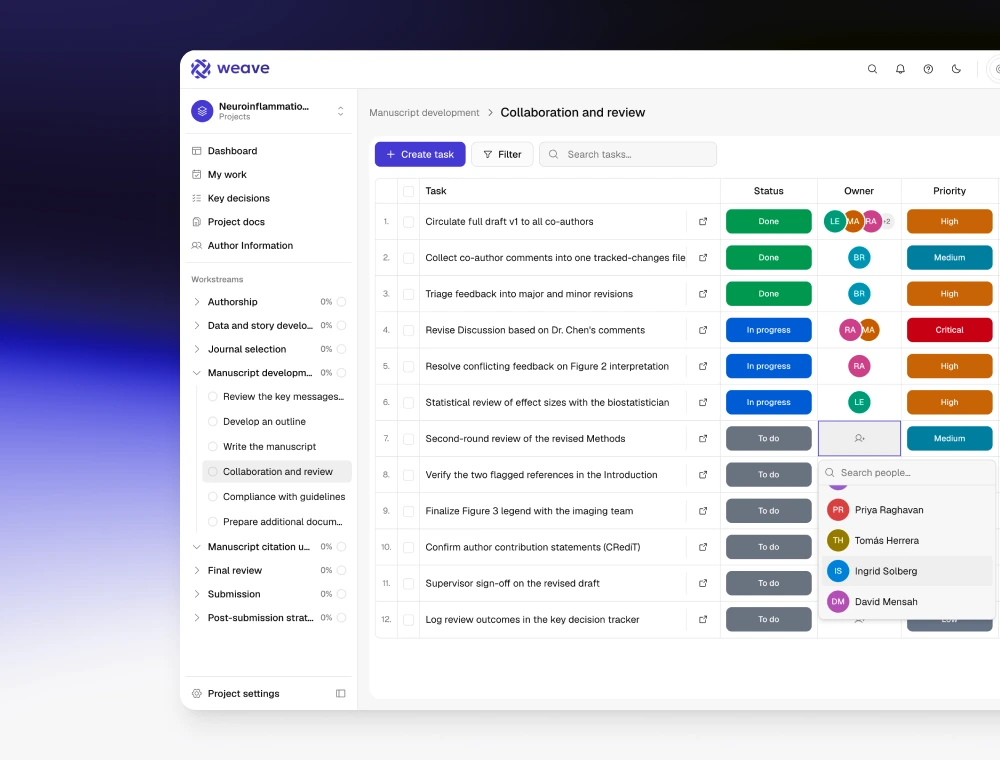
The manuscript development workspace.
Run the manuscript as a project, with every co-author in one workspace. Authorship, key decisions, the journal choice and the path to submission, tracked on the framework Scribendi and Edanz use with authors every day, with Weave AI beside you the whole way.
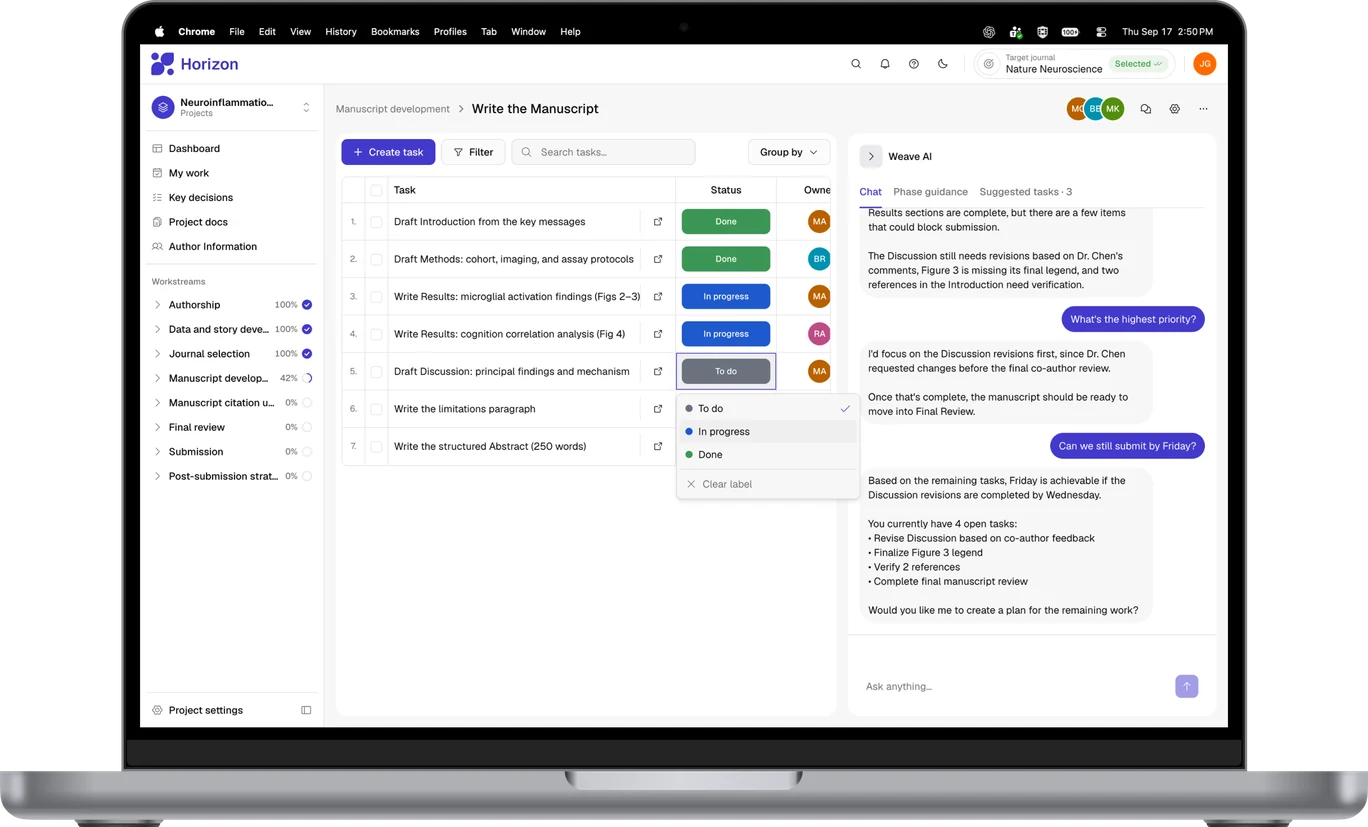
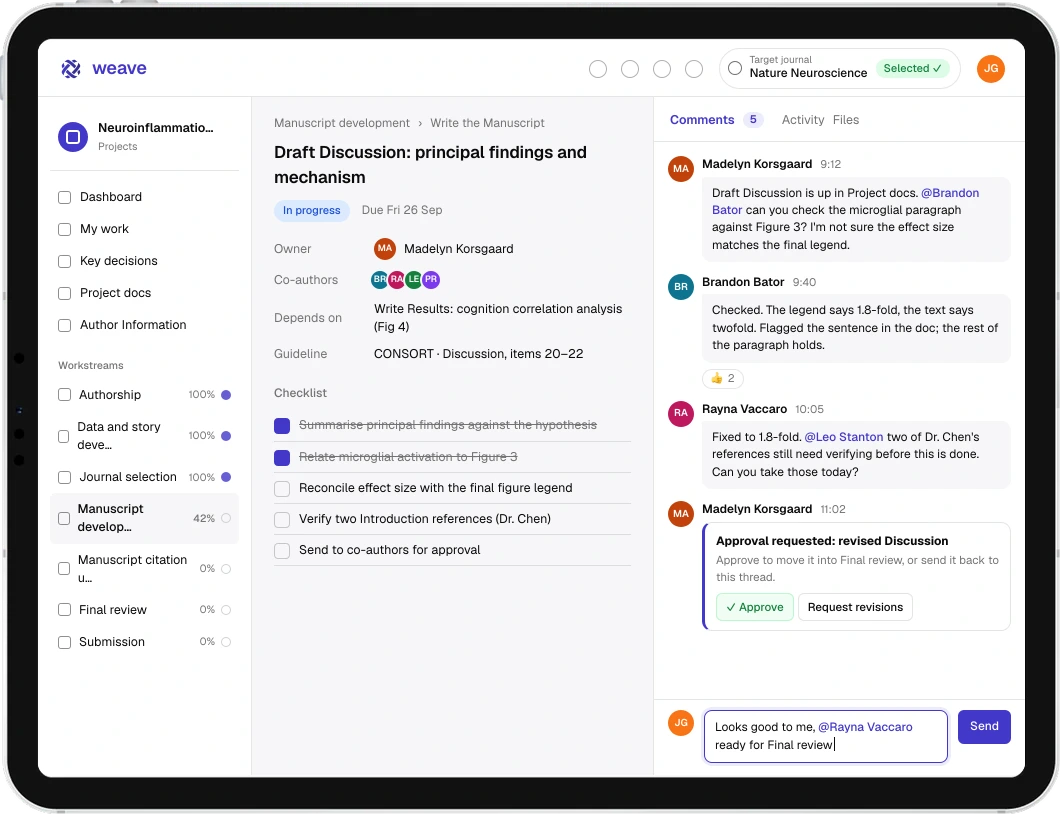
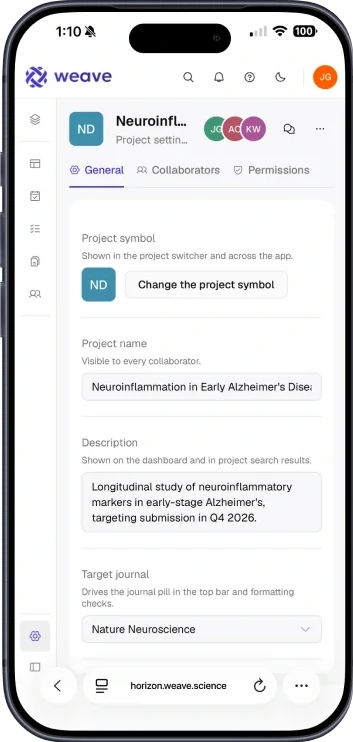
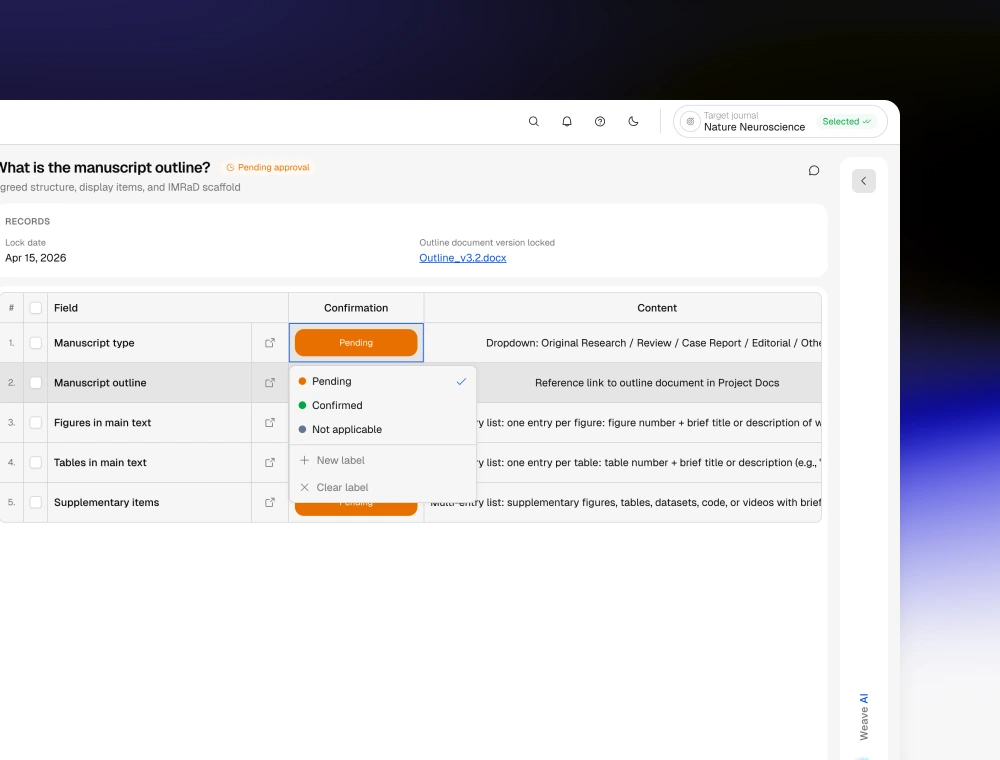
- Target journal always in sight
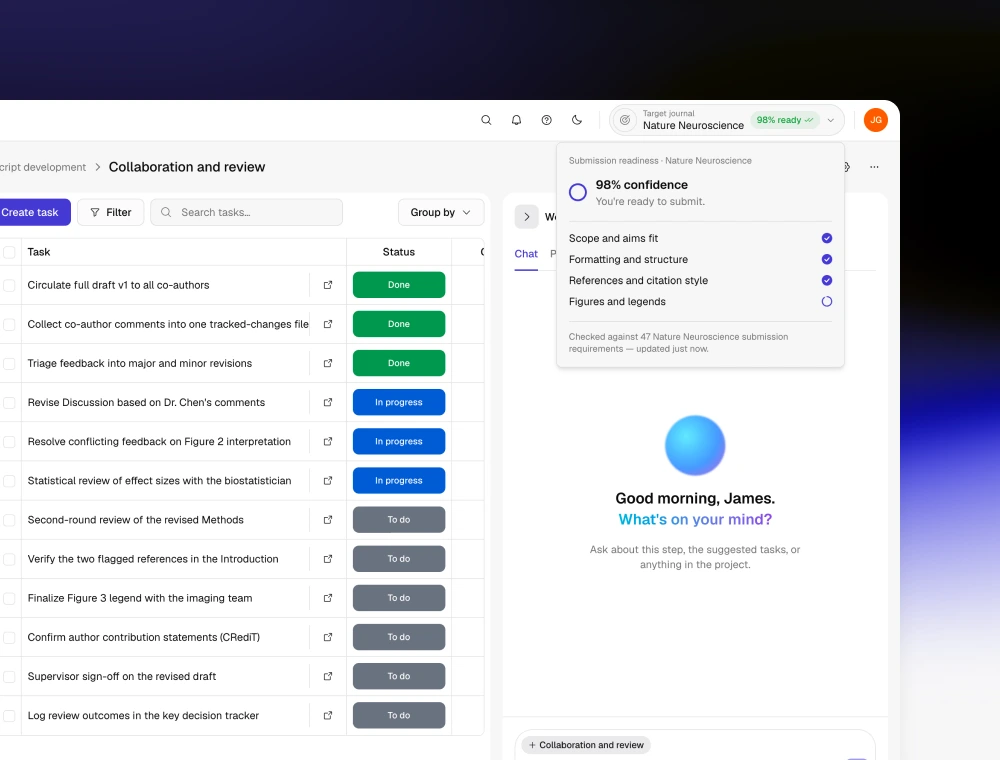
- Ask Weave AI anything
- Collaborate with co-authors
- Manuscript development framework
- A workspace for every manuscript
- Tasks, deadlines, comments, roles

From first author to submission.
Set up the project and every stage of the framework becomes work you can assign, track, and decide on together. Click a step to see it.
Create the project and every stage becomes a workstream, from authorship to post-submission, with Weave AI's suggested tasks ready to import.
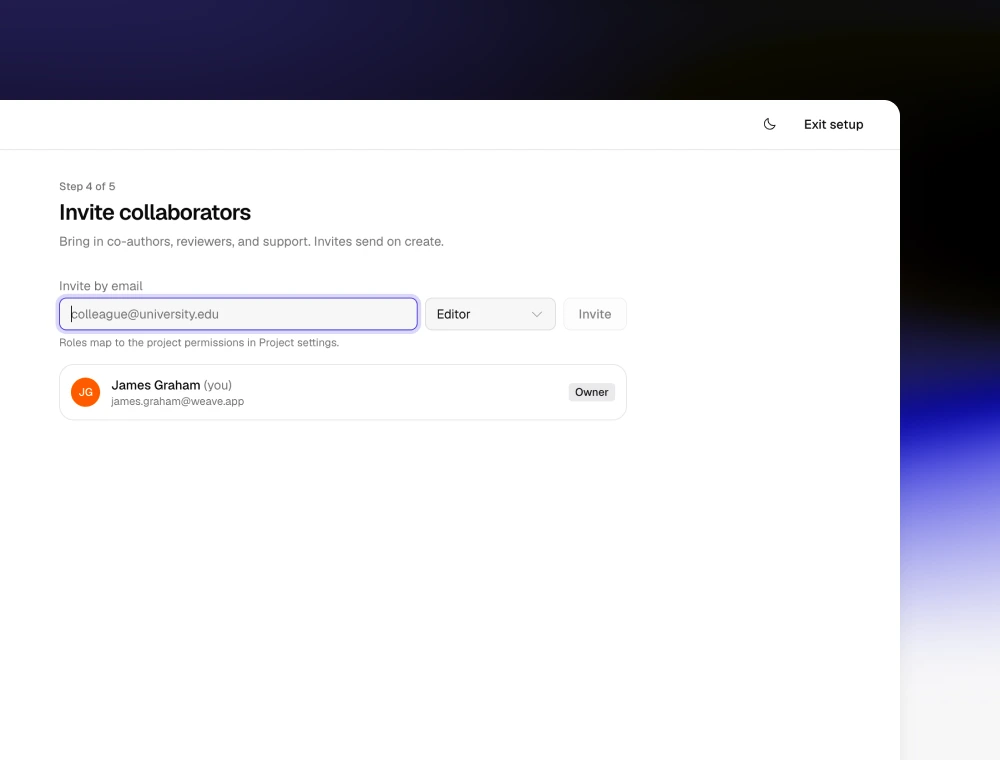
Built on a framework that gets papers published.
Nine stages, from data to submission, codified by Scribendi and Edanz across decades of manuscripts. Every Horizon workstream starts here.
Author Information Gathering
Author Information Collection
- Gather detailed contact information for all co-authors, including affiliations and ORCID IDs.
- Use a standardized form to ensure completion of required fields (e.g., names, initials, research field, ORCID, affiliations, contact information, academic positions, keywords).
- Optional fields may include mobile number, LinkedIn handle, X handle, profile photo, society memberships, etc.
Managing COI (Conflict of Interest) and Funding Disclosures
- Collect COI declarations from each author according to ICMJE standards.
- Securely store COI documentation and provide reminders to keep it updated.
- Gather details of all funding sources, documenting the role of funders for disclosure in the manuscript and submission system.
- Confirm additional requirements from funders, such as open-access stipulations.

Weave AI
The intelligence behind your manuscript.
Weave Horizon is the manuscript development workspace for neuroscience teams. Weave AI, trained on neuroscience research, plans the work from the framework, knows everything in the project, and tells you when it's ready to submit.
Plans the work
Every stage of the framework comes with Weave AI's suggested tasks, ready to import and assign.
Knows the project
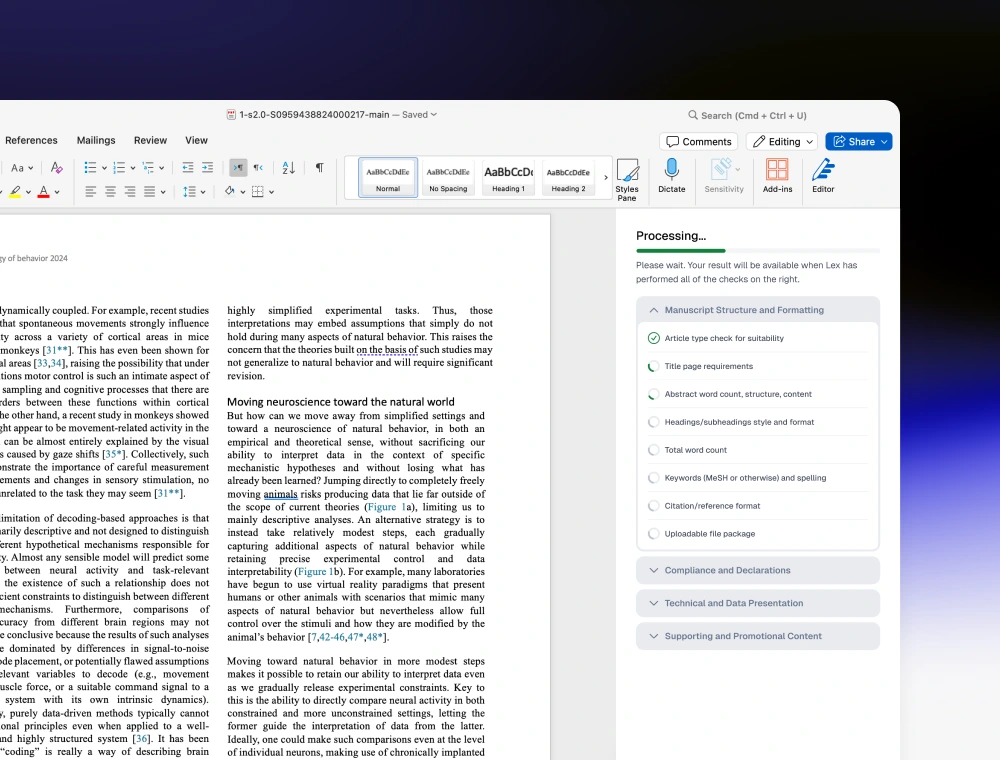
The papers from Stream, the target journal and its requirements from Atlas, your drafts, reviews, and anything you upload: all of it in Weave AI's context.
Reviews before you submit
Mock peer review, claim checks, and a readiness score against the target journal, all before a referee sees it.
Where the project lives
Collections from Stream and the target journal from Atlas arrive in the Horizon project, and the draft is written in Weave for Word with all of it in view. Same project, same Weave AI, all the way through.
- Streamcollections
- Atlastarget journal


- Weave for Wordthe draft

Built for manuscripts.
Decisions, authorship, the target journal, reporting guidelines and the manuscript's own workspace: the parts of manuscript development that no general project tool has.
Everything you'd expect from a project tool.
Audit logs, notifications, comments, Gantt charts, calendars, roles and permissions: the essentials of the best project management tools, built in.
Audit log
Every action recorded, so who changed what, and when, is never in question.
Notifications and alerts
Deadlines, changes and mentions, in the app, by email or by SMS.
Comments and mentions
Discuss a task where it lives and pull in the right co-author with a mention.
Tasks and dependencies
Owners, priorities, deadlines and dependencies on every task, so nothing starts before what it depends on is done.
Gantt and progress charts
Milestones and dependencies on a timeline the whole team can read.
Calendars
Synced deadlines and milestones keep every contributor on schedule.
Roles and permissions
Admin, editor, reviewer, contributor and viewer, set per workspace.
Project health
Planned against actual progress, overdue items and risks, on a dashboard you can tailor.
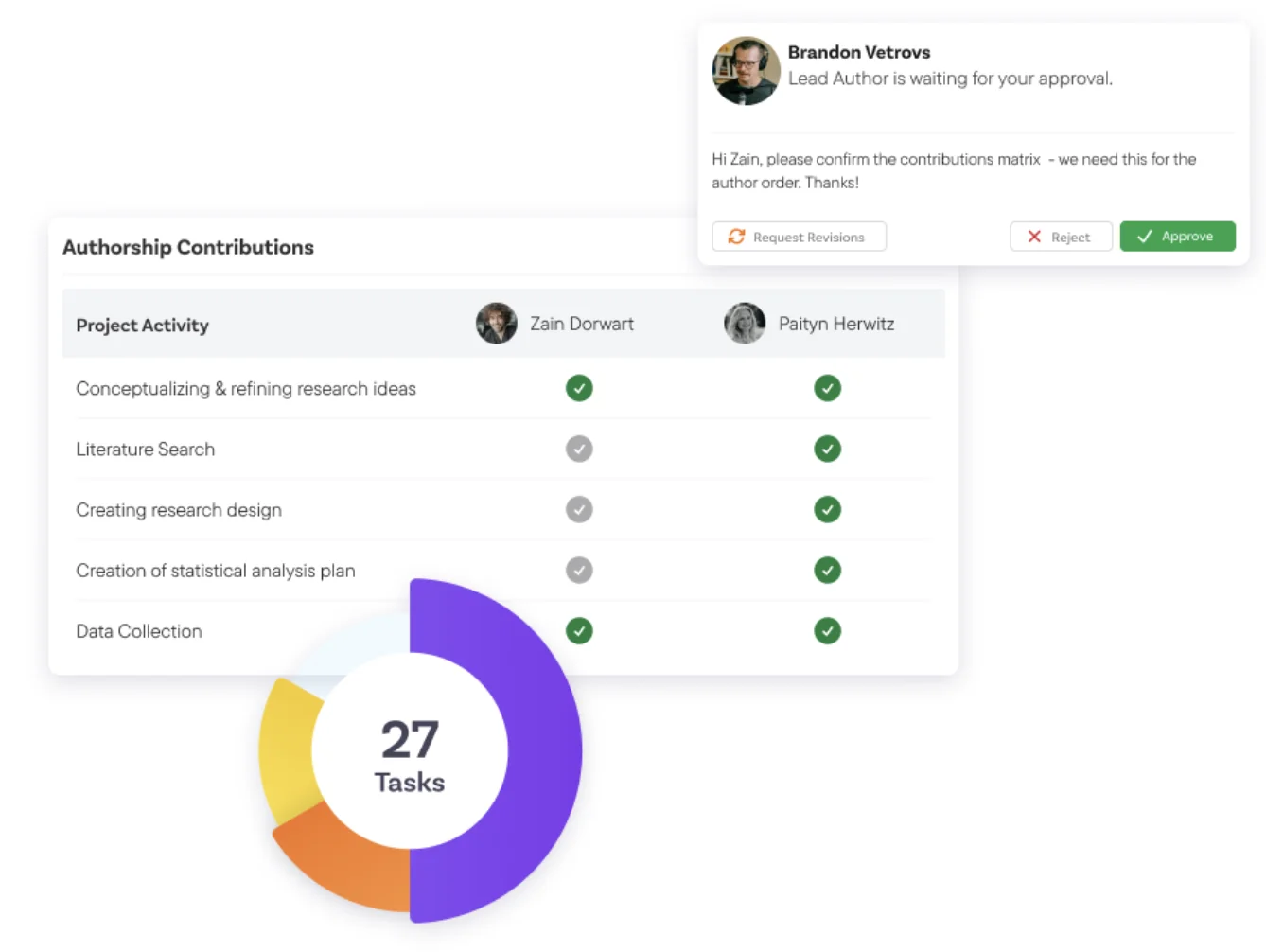
Authorship, on the record.
Contributions are recorded against CRediT as the work happens, authorship is tested against the ICMJE criteria, and every author approves the list. Raised early, kept current, and defensible when it counts.
- Contributor Role Taxonomy (CRediT)
- International Committee of Medical Journal Editors
A human expert, inside the workspace.
One button in Horizon reaches an editor or subject-matter scientist at Scribendi or Edanz, with two decades of manuscripts in your field behind them. They pick up where Weave AI leaves off.
- Scientific content development
- Publication strategy, even after a rejection
- Editing to your target journal's standard
- Submission, and the response to reviewers
Research Consultant
Katherine Halievski, PhD
Neurobiology
Katherine holds a PhD in Neuroscience from Michigan State, was a L'Oréal-UNESCO fellow at SickKids, Toronto, and reviews for Nature Medicine. She drafts your response to reviewers with you, separating the comments that need new data from those that need clearer writing.
Your research stays yours.
Weave AI reads your manuscript and learns your project to do the work you asked for. That is the only thing that happens to either.
Never trained on.
Your papers are not training data. Nothing you upload teaches the model anything.
Never sold or shared.
Not to advertisers, not to data brokers, not to anyone. Your manuscript is not a product we have for sale.
Never read by us.
No one at Weave opens, reviews or samples your manuscript. A human expert reads it only when you ask one to.
Encrypted throughout.
In transit and at rest, from the moment a file reaches us.
Yours to take back.
Delete a manuscript and it is gone. Take your work back out whenever you want.
Free in beta.
Weave Horizon is free for everyone in the beta, with no credit card. Pricing terms will follow the launch, and beta members will hear them here first.
Questions about Weave Horizon
Quick answers to the questions we hear most.
Is Weave Horizon free?
Free in beta, with no credit card. Pricing terms will follow the launch, and beta members will hear them first.
When can I use it?
Horizon arrives in early 2027. Get early access and we will tell you the day it opens; early-access members get in first. The same account works in Weave Stream today, so you do not have to wait to start.
How is Horizon different from a general project-management tool?
It is built around the manuscript itself: a development framework codified by Scribendi and Edanz, the target journal's requirements and a readiness score, key decisions with an audit trail, CRediT and ICMJE contribution tracking, EQUATOR checklists and reviewer response tracking, with Weave AI planning the work and reviewing the draft. A general tool models none of that.
Do I need Stream or Atlas?
No. Horizon works on its own. Connect a Stream collection or set a target journal in Atlas and they join the project's context, and the same account works across Weave.
Will my co-authors need to learn a new tool?
No. Co-authors join the workspace with the role you give them, see only what that role allows, and hear about tasks, mentions and deadlines by email. There is nothing to install.
Is my manuscript used to train Weave AI?
No. Weave AI reads your project to do the work you ask for, and for nothing else. No one at Weave reads it unless you ask an expert to.
Can I get expert support inside Horizon?
Yes. One button reaches an editor or subject-matter scientist at Scribendi or Edanz, for content development, publication strategy, editing, submission and the response to reviewers.